
Maths
At Deanery, we believe mathematics helps children understand and shape the world around them. We want every child to enjoy maths, think deeply and become a confident, curious and resilient mathematician.
Through an ambitious, inclusive curriculum, children develop fluency, reasoning and problem-solving skills. The children make connections, recognise patterns and learn that mistakes are valuable opportunities to improve. Our mastery approach builds secure foundations and prepares children for future learning.
Talk and Vocabulary
Mathematical understanding grows when children have opportunities to articulate their thinking, listen carefully to others and explain their reasoning. Oracy is therefore an integral part of our mathematics teaching.
Through structured partner talk, mathematical discussions, collaborative problem-solving and purposeful questioning, children learn to communicate their ideas clearly and confidently.
We encourage pupils to:
- Explain how they reached an answer and justify their reasoning.
- Compare different methods and consider which approach is most effective.
- Ask thoughtful questions, challenge ideas respectfully and learn from alternative perspectives.
- Use evidence to support their mathematical arguments.
- Listen actively and build on the ideas of others.
We make vocabulary teaching purposeful through:
- Explicit teaching and modelling of new mathematical terms.
- Visual representations, concrete resources and examples to develop understanding.
- Opportunities to hear, rehearse and apply vocabulary in discussion.
- Regular revisiting of previously taught words to strengthen long-term retention.
- Encouraging children to explain the meaning of mathematical language and use it accurately in different contexts.
By removing barriers created by unfamiliar language, we help every child access mathematical learning, communicate their ideas and develop a secure foundation for future success.
Through mathematical exploration, pupils may encounter the beauty of symmetry in flowers, repeating patterns in natural forms, the structure of shapes in architecture or the remarkable relationships found in numbers.
We also nurture patience, perseverance, humility and respect for the ideas of others. Children learn that understanding often develops gradually and that there is value in questioning, exploring and remaining open to new possibilities.
Real-Life Learning
Mathematics is all around us. Children explore how maths is used in everyday life, from managing money and measuring distances to understanding data and recognising patterns in nature.
We make meaningful connections between classroom learning and the wider community, helping children understand that mathematics has a purpose beyond the classroom.
Wonder and Reflection
Mathematics offers rich opportunities for spirituality through moments of wonder, discovery, reflection and connection.
We create opportunities for children to pause, wonder and reflect:
- Wonder: What patterns can we discover? What surprises us about the world of numbers?
- Connection: How are mathematical ideas linked to nature, art, music, architecture and the world around us?
- Reflection: What have we discovered? Has our thinking changed? What questions do we still have?
- Perspective: How might someone else approach this problem? What can we learn from a different way of thinking?
- Gratitude and appreciation: How does mathematics help us recognise beauty, order and creativity in everyday life?
Through questioning, exploration and reflection, the children learn to appreciate different perspectives, persevere through challenges and remain open to new ideas.
Every Child Flourishes
We are committed to ensuring that every child experiences success, challenge and enjoyment in mathematics. Through high-quality teaching, carefully planned progression, inclusive approaches and opportunities to think deeply, we aim to develop mathematicians who are fluent, articulate, resilient and reflective.
From the Early Years onwards, we nurture mathematical curiosity through play, practical experiences and carefully sequenced learning. Every child is supported and challenged to achieve their best.
Our aim is for every pupil to leave Deanery with secure mathematical knowledge, the confidence to tackle unfamiliar problems, the language to explain their thinking and the wisdom to apply their learning thoughtfully.
What maths looks like
Each maths lessons begins with a settling down activity which is a revision of 8 questions. The is a vital part of each maths lesson and helps the children to make links with their previous learning and what they are learning now.
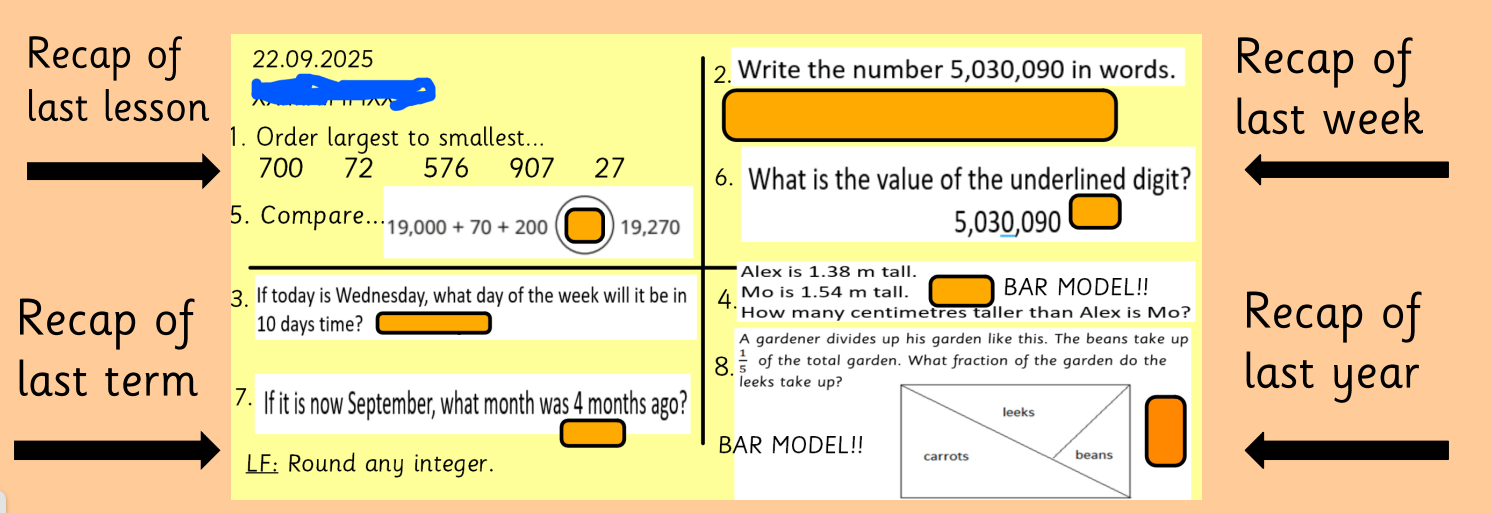
Teaching and learning of a specific skill is then followed, modelling through concrete, pictorial and abstract methods and with use of key mathematical vocabulary. The concrete (practical learning) of maths is a fundamental stepping stone to support all children’s understanding of number and skills before progressing to presenting problems pictorially and then in more formal, abstract methods.
Through mathematics, our children learn to reason, question, connect and flourish — ready to make a positive difference in the world.
Below you can find some key documents that share more about what maths teaching and learning looks like at Deanery:
Information for parents is available here: Advice and guidance for parents | White Rose Maths
A number of home learning resources to support what is being taught in school can be found here: Maths home learning | Home learning | White Rose Maths
MULTIPLICATION CHECK When the children reach Year 4, over and above the usual practice and testing in school, they will undertake a statutory Multiplication Check on their times tables up to 12 x 12. There will be 25 questions in total, having 6 seconds to answer each question, with 3 seconds between questions.
Below is a link for children to practice their times tables, which mirrors the formal Multiplication Check. Hopefully this will help prepare the children for when they are tested in the Summer term.
Calculation policies for Addition and Subtraction and Multiplication and Division can be found by clicking on the buttons below.
Mathematics at Deanery is more than numbers—it’s about thinking deeply, solving problems, and discovering the joy of learning.
Simple ways to practise maths at home
Try these everyday activities:
- Shopping: Add prices, calculate change and compare offers.
- Cooking: Weigh ingredients, read scales and double or halve a recipe.
- Times tables: Practise little and often using games, songs or quick-fire questions.
- Telling the time: Read clocks, work out durations and plan journeys.
- Board games and cards: Develop counting, number recognition and mental arithmetic.
- Talk about maths: Ask, “How did you work that out?” or “Can you find another way?”
Other links:
1 minute maths – White Rose
An excellent app for to revise fluency.
https://whiteroseeducation.com/1-minute-maths
Numbots and Timestables Rockstars
Supports fluency and pace.
BBC Bitesize – Primary Maths
Child-friendly explanations, videos and quizzes to help children revisit key concepts and practise independently.
Topmarks – Maths Games
Fun, interactive games for practising number bonds, counting, times tables and other essential maths skills.
NRICH Maths – Problem-Solving Activities
Free activities that encourage children to reason, spot patterns, explain their thinking and solve problems together. Resources are grouped by age.
National Numeracy – Family Maths Toolkit
Practical ideas for building maths into everyday family life, helping parents feel more confident even if maths wasn't their favourite subject at school.
Mathsframe – Maths Practice
Interactive games and practice activities covering many KS1 and KS2 topics, including times tables and arithmetic.
You can access these using this link: Parent resources | Maths workbooks | White Rose Maths
What is Mastering Number?
Mastering Number is a national maths programme developed by the National Centre for Excellence in the Teaching of Mathematics (NCETM) and delivered through England's Maths Hubs. It helps children develop a deep understanding of numbers, build fluency and become confident mathematicians.

NCETM
The main aim is to help children understand how numbers work and relate to one another, rather than simply memorising number facts or learning procedures.
What does it look like in the classroom?
1. Developing number sense
Children learn to recognise small quantities without counting each object (subitising), understand how numbers can be partitioned and spot patterns.
2. Using practical resources
Children use resources such as counters, ten frames and rekenreks (bead frames) to see and explore mathematical relationships.
3. Talking about maths
Teachers model mathematical vocabulary and use carefully structured sentences to help children explain their thinking and understand concepts.
For example, rather than only learning that 7+3=10, children explore how seven and three combine to make ten, how the parts can be rearranged and how this knowledge helps them solve other calculations.
Which year groups does it support?
|
Year group |
Main focus |
|
Reception |
Building early number sense and understanding quantities |
|
Year 1 |
Developing number relationships and fluency with number facts |
|
Year 2 |
Securing number knowledge to support efficient calculation |
The Reception and KS1 programme uses short, regular teaching sessions, with resources and training provided for participating schools.
Why is it important?
Mastering Number aims to help children:
- Develop a secure understanding of number.
- Recall key number facts accurately and efficiently.
- Recognise patterns and relationships between numbers.
- Explain their mathematical thinking.
- Build confidence for more complex learning in later year groups.
You can find out more on the official NCETM website: