Spirituality
Spirituality is a complex and abstract concept, which is unique to each of us. We believe that spirituality is the opening of hearts and minds, through reflection, and the questioning of the world. It is the opportunity for us to discuss and challenge the wonder and the challenges we see in our world. It is awareness that there is something more to life than meets the eye, something more than the material, something more than the obvious.
Our aim is to help pupils to flourish and to enjoy life in all its fullness as good, kind citizens of the world. We want pupils to question and wonder and see the whole of life.
In school, we promote spiritual development in a myriad of ways and try to think of this linked to SELF, OTHERS, WORLD and BEYOND. Spirituality is like the wind. It can’t be seen but felt. Spirituality is mentioned in the Children Act 1989 and is an important aspect of human development.
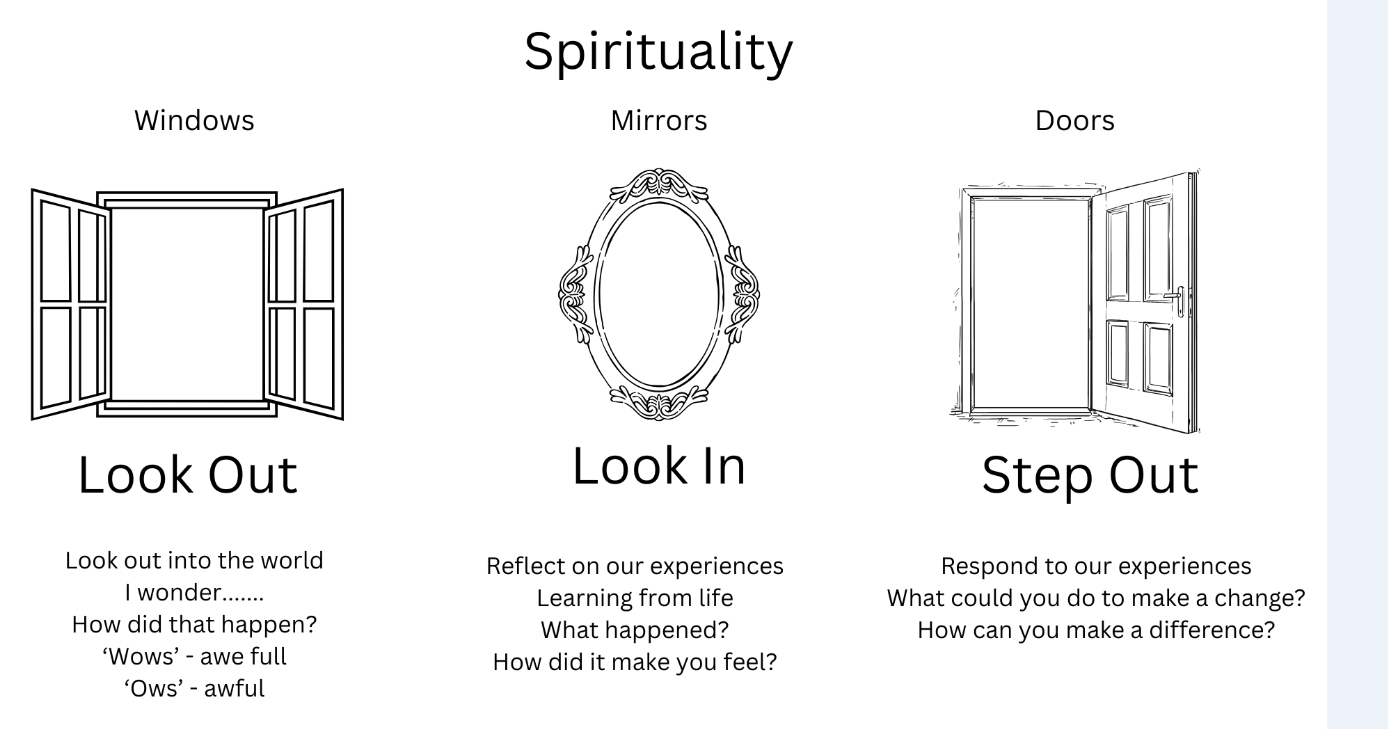
In Collective Worship, we use 'Windows, Mirrors and Doors' to help structure the theme we are discussing and provide opportunities for deep reflection.
Windows, Mirrors and Doors: Our Approach to Spiritual Development
At our Church of England Primary School, we are committed to providing an education that nurtures the whole child. Spiritual development is a central aspect of this commitment. We adopt the recognised framework of “windows, mirrors and doors” to ensure that children experience a rich and balanced approach to spirituality that is both deeply Christian and inclusive of all.
Windows – encounters with the wider world
Windows allow pupils to observe and engage with the world beyond themselves.
Through collective worship, outdoor learning, through the diversity of our school community and throughout the wider school curriculum pupils gain insight into different perspectives, cultures and faiths. This fosters empathy, respect and an appreciation of the richness of God’s world. We also use the language of ‘wows’ and ‘ows’ to help children to differentiate between moments that are ‘awe full’ and ‘awful’.
Mirrors – opportunities for self-reflection
Mirrors provide structured moments for pupils to reflect on their own beliefs, values, feelings and experiences.
Through quiet reflection, prayer and discussion, pupils are encouraged to explore their identity and recognise their intrinsic worth. Some subjects and times allow for this specifically, such as PSHE, religious education and collective worship but in all subjects, there will be opportunities, unexpected or planned, when things just ‘crop up’. Handled sensitively, it is possible to make the most of all these times.
This supports the Church of England’s vision that each person is made in the image of God and is of infinite value.
Doors – responses and actions
Doors provide opportunities for pupils to respond to what they have encountered or reflected upon. This can simply be done through a change in attitude or behaviour or thinking. It can also be expressed powerfully through music or art or drama or dance and through some form of social action or specific acts of giving.
Examples include participation in worship, leadership roles or ethical decision-making. At the Deanery school specific examples of this are the support of three charities each term chosen by the house captains as well as the work of elected members of school council, eco council and the spiritual ambassadors.
Through such actions, pupils are supported to live out Christian values such as compassion, responsibility and hope.
Our Commitment
By integrating windows, mirrors and doors throughout school life, we aim to cultivate a thoughtful, reflective and compassionate school community. This approach aligns with the Church of England Vision for Education—promoting wisdom, hope, community and dignity—and supports pupils in developing the spiritual awareness and moral integrity needed to contribute positively to society.
Structures which support our understanding of Spirituality
The Bible talks about how God creates everyone in God's image. It also describes God as a potter and describes everyone being the work of God's hand. 'We are the clay, and you are the potter; we are all the work of your hand' (Isaiah 64:8)
Moments in our life can be called 'WOWs', 'OWs' and 'NOWs'
The 'WOWS' are the 'awe' and 'wonder' moments. These times when you want to breathe in and capture the feeling, holding onto it as long as you can.
The 'OWs' are the 'blows' life can bring. They can knock the breath out of you.
The 'NOWs' are the every day ordinary times: being able to be present in the moment, being open and aware of everything going on around you'

Sometimes, pots can crack or break. Sometimes things happen that can make us feel cracked or changed. We believe that whatever happens to us in life, God is with us. God can fill and mend gaps and put everyone back together.
Spirituality can be seen as the glue which can fill the gaps that may be caused by the 'OWs', the 'WOWs' and the 'NOWs' of life.
The wow moments where our heart sings, you feel blessed, you gasp with excitement or feel truly happy!
There are times when we are brought up short, shocked, saddened or surprised. This is also a time when Spirituality is incredibly important, in order to give us strength and hope to pull through these difficult times. “Our greatest time of growth is in our greatest time of disorientation.”
Spiritual development may come through the curriculum e.g. through explicit reflection of SELF in PSHE lessons or consideration of OTHERS in our team work during PE. Sometimes though, it is through the wider school life where we encourage Spiritual Development; the books we provide in our library actively promotes inclusivity and knowledge of the WORLD around us. Examples of how Spirituality is built through the curriculum can be seen in the curriculum overviews below.
We use BIG questions (see link website page) as a platform to engage in discussion about life and the world around us. These provide an opportunity to think deeply about important issues and qualities of life. The questions link to our focus value for each half term and these are progressive from Reception to Year 6.